Roy Emery, G3FYX – 6 June 2026
It is with great sadness that we announce the passing of Roy Emery, G3FYX at the age of 95. A respected friend, mentor, and one of the United Kingdom’s most accomplished amateur radio operators.
Known throughout the amateur radio community by his callsign G3FYX, Roy earned widespread admiration for his pioneering work in the demanding field of microwave communications. Based in Bristol, he was a lifelong enthusiast whose fascination with radio began in his youth. Long before obtaining an amateur radio licence, he recalled unofficially transmitting the sound of a ticking clock to the home of his childhood friend, Mervyn, a small but telling sign of the curiosity and ingenuity that would define a lifetime in radio.
When Roy eventually obtained his first amateur radio licence, he was still only 19 years old, and the licence had to be issued in the name of his father, Bert. From those early beginnings, he embarked on a journey through amateur radio that would span decades and encompass everything from Morse code operation on the HF bands to pioneering work at the highest microwave frequencies.
One of Roy’s most remarkable experiences as a radio amateur came on 22 November 1963. While operating from home, he received a message from a contact in the United States reporting that President John F. Kennedy had been assassinated. Recognising the enormity of the news, Roy immediately sought confirmation from another American station and received independent corroboration. He then informed his wife and eight-year-old son, notably before the news appeared as a newsflash on BBC radio or television. Through the worldwide network of amateur radio operators, Roy was among the first people in Britain to learn of one of the most significant events of the twentieth century.
Following his retirement, amateur radio became an even greater source of enjoyment and purpose, allowing him to combine his practical engineering skills, mechanical expertise, and endless curiosity in pursuit of ever more challenging projects.
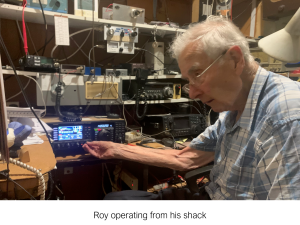
Roy was an exceptional constructor and engineer. During his working life he developed mechanical skills that later proved invaluable in designing, building, and refining sophisticated microwave equipment. Many will remember the remarkable shack just outside his back door, where countless projects were conceived, assembled, tested, and improved.
His contributions to amateur radio were considerable. He was a long-standing member of the UK Microwave Group and a leading figure in the development and operation of equipment on the higher amateur bands. Together with G4KNZ, he established a UK distance record on the 47 GHz band in 1996 and extended that record to 65 kilometres the following year. He engineered the 24 GHz microwave beacons at the Isle of Wight (GB3IOW) and Cardiff (GB3AMU), providing valuable resources for fellow enthusiasts and helping to advance microwave experimentation throughout the United Kingdom.
Roy’s achievements were recognised by several prestigious awards. In 1997, he shared the Fraser Shepherd Award with Phil Schorah for their research into microwave applications to radio communication. In 2008, he was among the members of the Wessex Microwave Group—alongside G8BKE, G8ACE and G3PYB—who were awarded the G3BNL Trophy for their outstanding work in 76 GHz equipment construction and operation.
Although best known for his microwave work, Roy’s interests spanned almost the entire amateur radio spectrum. He was an ardent and highly accomplished Morse code (CW) operator, spending many enjoyable hours on the HF bands, particularly on 20 metres, and maintaining regular contacts with friends on 80 metres. A skilled and fluent Morse operator, Roy possessed the enviable ability to hold a brief conversation with a visitor while continuing to send and receive Morse code, a talent that never failed to impress those fortunate enough to witness it.
Roy took particular pride in his collection of QSL cards confirming contacts made on 24 different amateur radio bands. Remarkably, contacts on 21 of those bands were achieved using equipment he had designed and built himself, a testament to both his engineering ability and his determination to explore almost every corner of the amateur radio spectrum.
Whether operating from his Bristol home station or setting up portable stations on hilltops and high ground across the country for microwave contests and activity days, Roy approached every challenge with patience, ingenuity, and meticulous attention to detail. Portable microwave operation demanded long hours, careful planning, and the transportation, assembly, and testing of complex equipment in often challenging conditions. Undeterred by summer heat, driving rain, or biting winds, Roy relished the opportunity to take his equipment into the field in pursuit of new contacts and technical achievements.
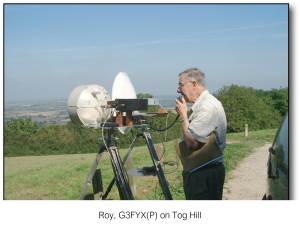 On one memorable occasion, his unusual array of antennas and equipment attracted the attention of suspicious authorities, who questioned what exactly he was doing on a remote hilltop. Such encounters were accepted with good humour as part of the adventure of a hobby that continually took him beyond the comfort of the shack and into the countryside in search of ever more challenging operating opportunities. On family holidays, his daughter recalls that he would seek high points, such as Hardy’s Monument, from which to operate.
Roy’s amateur radio activities were supported throughout by his wife, Mary, whose hospitality became well known to many visiting radio amateurs. Fellow operators who called by the shack could often rely on a warm welcome, accompanied by Mary’s much-appreciated cups of coffee and home-made cake. While Roy’s achievements on the air were his own, friends recognised that Mary’s encouragement, patience, and support formed an important part of the environment in which his lifelong passion for amateur radio flourished.
Yet those who knew Roy best will remember much more than his technical achievements. They will remember a man who was generous with his time and knowledge, always willing to help others with projects, solve difficult problems, or offer encouragement to newcomers.
Roy found joy in learning, building, experimenting, and sharing his enthusiasm with others. His quiet determination, good humour, and willingness to take on challenges earned him the respect and affection of countless friends within the amateur radio community.
Roy leaves behind a legacy that extends far beyond records, awards, and equipment. Through the friendships he forged, the knowledge he shared, and the inspiration he provided to generations of radio amateurs, his influence will continue to be felt for many years to come.
He will be greatly missed by his family, friends, and the wider amateur radio community.
73, Roy. Thank you for the contacts, the conversations, and the inspiration.
Jim Emery (Roy’s son)
Category: Silent Keys