BBC Long Wave Shutdown

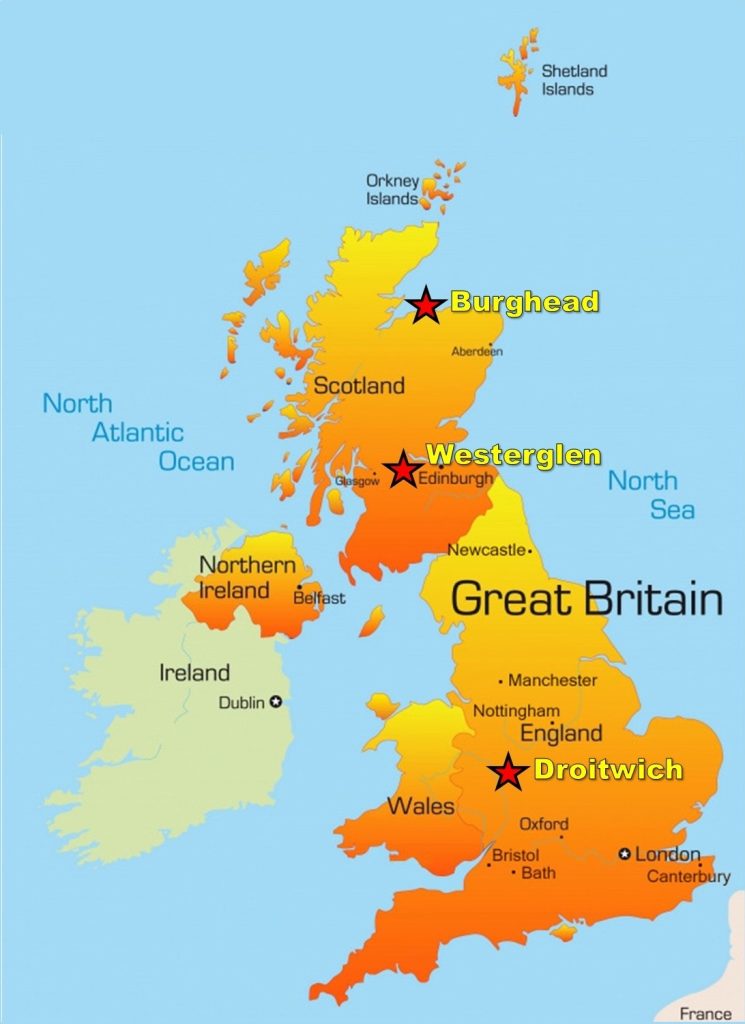
Radio 4’s Long Wave (LW) service on 198kHz will close on 27 June 2026. This was announced by the BBC on 11 May. Although expected in 2026, this date is earlier than was anticipated. On the air, the BBC have been more specific with the time given as 0100 BST (0000 UTC) on 27 June 2026. The Long Wave transmitting stations: Droitwich in Worcestershire, Westerglen near Stirling in Scotland and Burghead overlooking the Moray Firth also in Scotland, will all be closed down that day.
These closures have great significance for radio enthusiasts. Droitwich was commissioned in September 1934 – the BBC Long Wave transmissions have been ever-present for most of us. The signals have been used as frequency references for radio calibration, particularly prior to 1988 when the transmit frequency was 200kHz – close to a wavelength of exactly 1500m. We have listened to the Shipping Forecast, the “Sailing By” theme music, Test Match Special and much more. During WWII, the Long Wave signal was used to send coded messages to the French Resistance. The 198kHz signal has been used by utility companies to control off-peak energy meters.
The RSGB and the BBC Amateur Radio Group will be marking this occasion on the air and are looking for volunteers to activate a special call sign in the week leading up to and including the day of the closure. In addition three radio clubs have volunteered to activate special call signs to celebrate the almost 92 years of these historic transmitters, on the day that they are finally turned off.
The BBC Long Wave Transmitters
There is plenty of online history of the three transmitters so we will only provide very brief details here. All three transmitting stations were constructed in the early 1930s and are currently all close to 90 years old. The two Scottish transmitters were installed to ensure that, with Droitwich covering the whole of England and Wales, anywhere in the United Kingdom would have reliable reception of the BBC transmissions on Long Wave.
The Radio 4 LW signal from Droitwich covers most of England and Wales using 500kW. The two “supplementary” Long Wave transmitters at Burghead and Westerglen, are both 50kW.
Droitwich
Droitwich transmitting station is located just outside the village of Wychbold, near Droitwich in Worcestershire, England.
The foundations for the site were laid in May 1933. Initial transmissions were in July 1934. The first national transmissions were on Thursday afternoon, 6 September 1934. The full opening was on Sunday 7 October 1934.
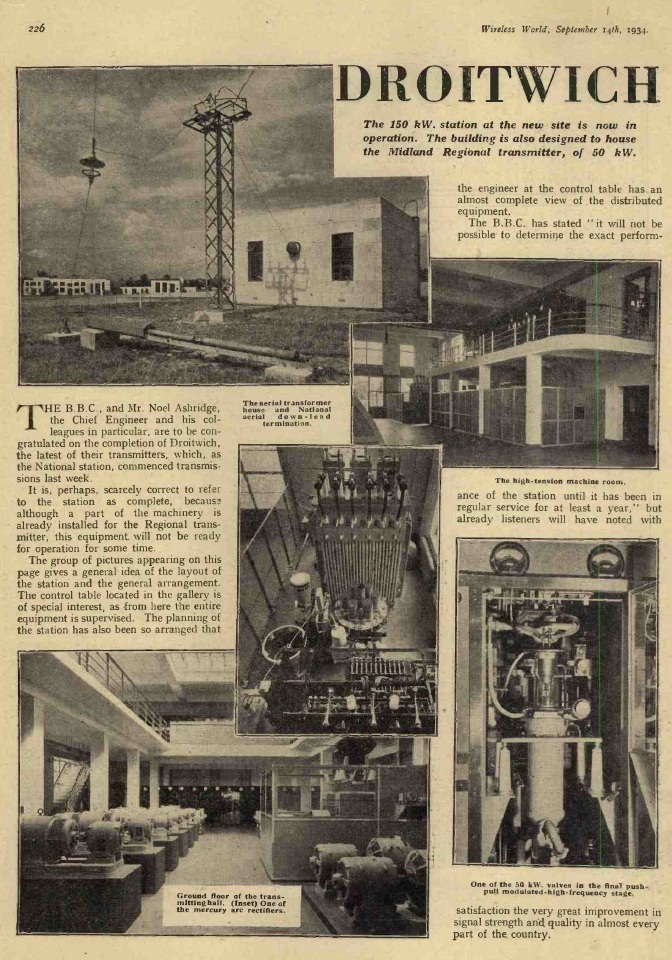
(from Wireless World 14 September 1934)
For Long Wave at Droitwich, a Marconi T aerial is used, which is suspended between two 213-metre-high guyed steel lattice masts, which stand 180 metres apart.
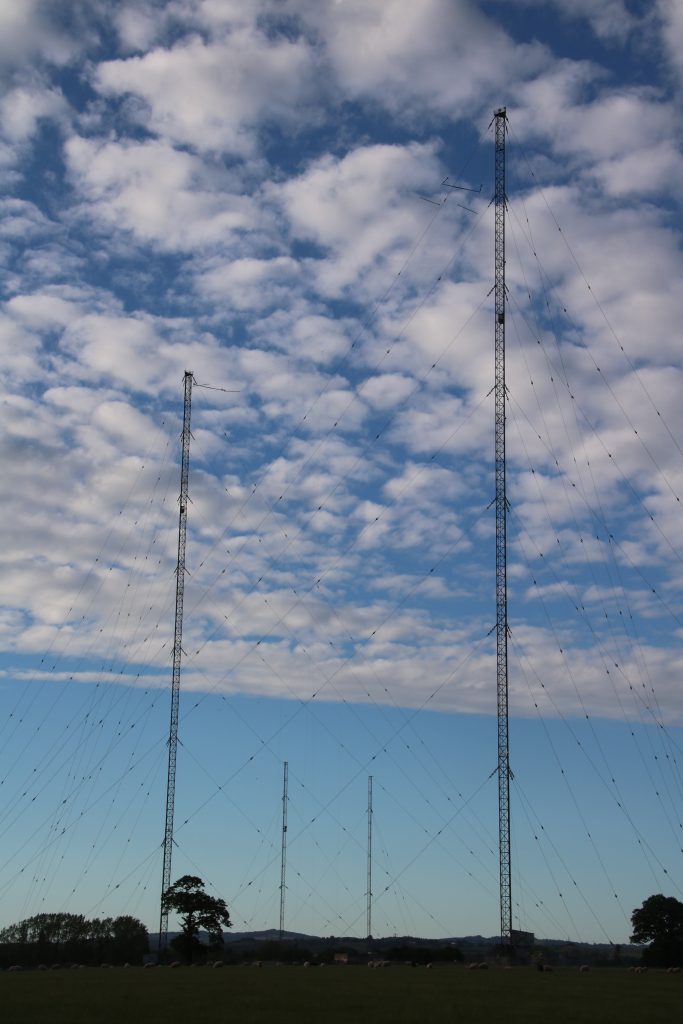
(The Droitwich Aerials, 29 May 2026 – Photo from , used with their kind permission)
Such was the importance of the Droitwich Long Wave transmissions, that wireless sets built in the UK in the 1930s had “Droitwich” clearly indicated on the Long Wave dial, at a wavelength of 1500m.
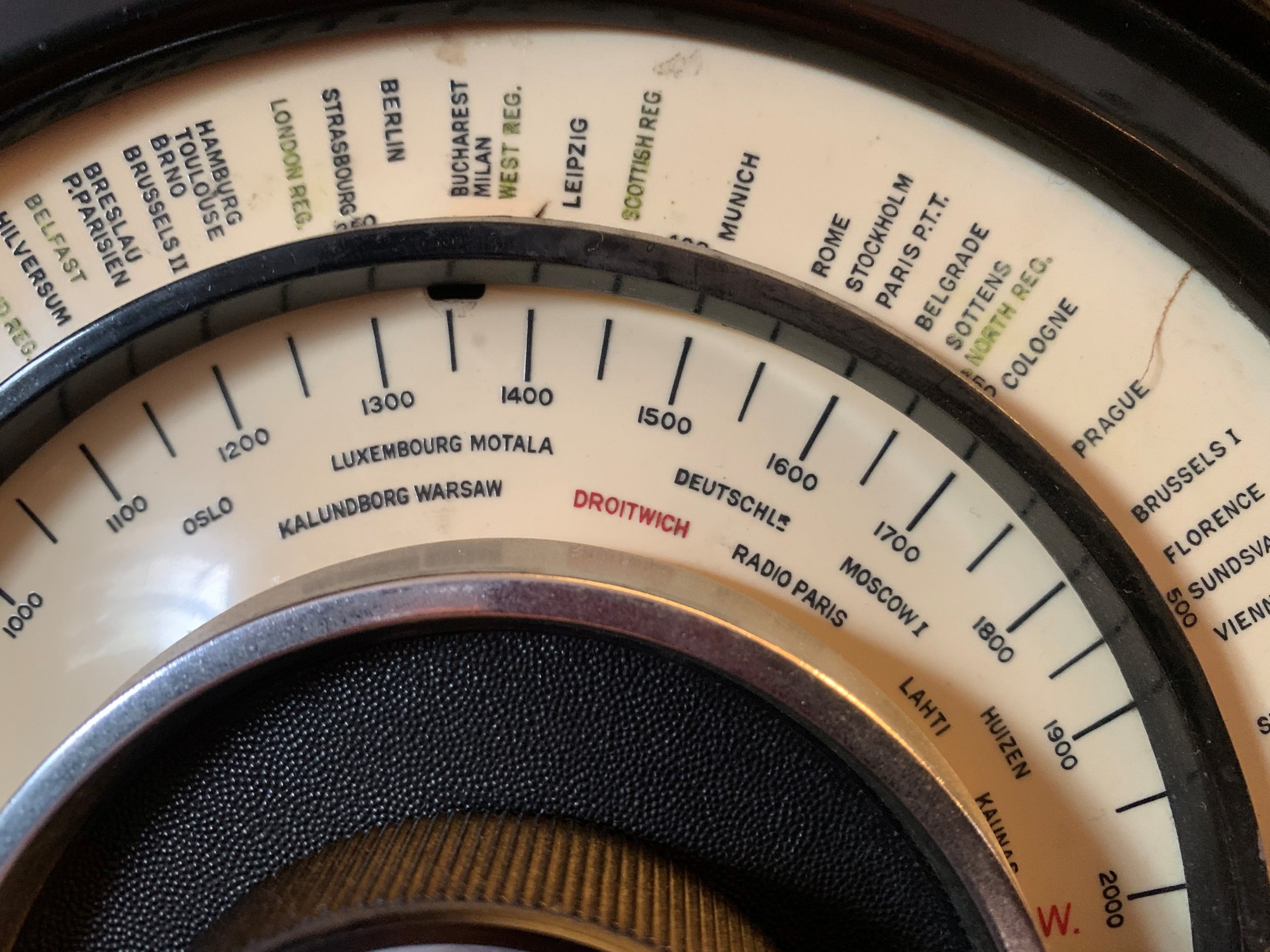
(1935 EKCO AC86 Dougall – Photo from Dave Shaw G4NOW, used with their kind permission)
Westerglen
Westerglen transmitting station is located 2 miles (3 km) southwest of Falkirk, Stirlingshire, Scotland.
Test transmissions began in April 1932 and the National programme began on Sunday 25 September 1932, two years ahead of Droitwich.
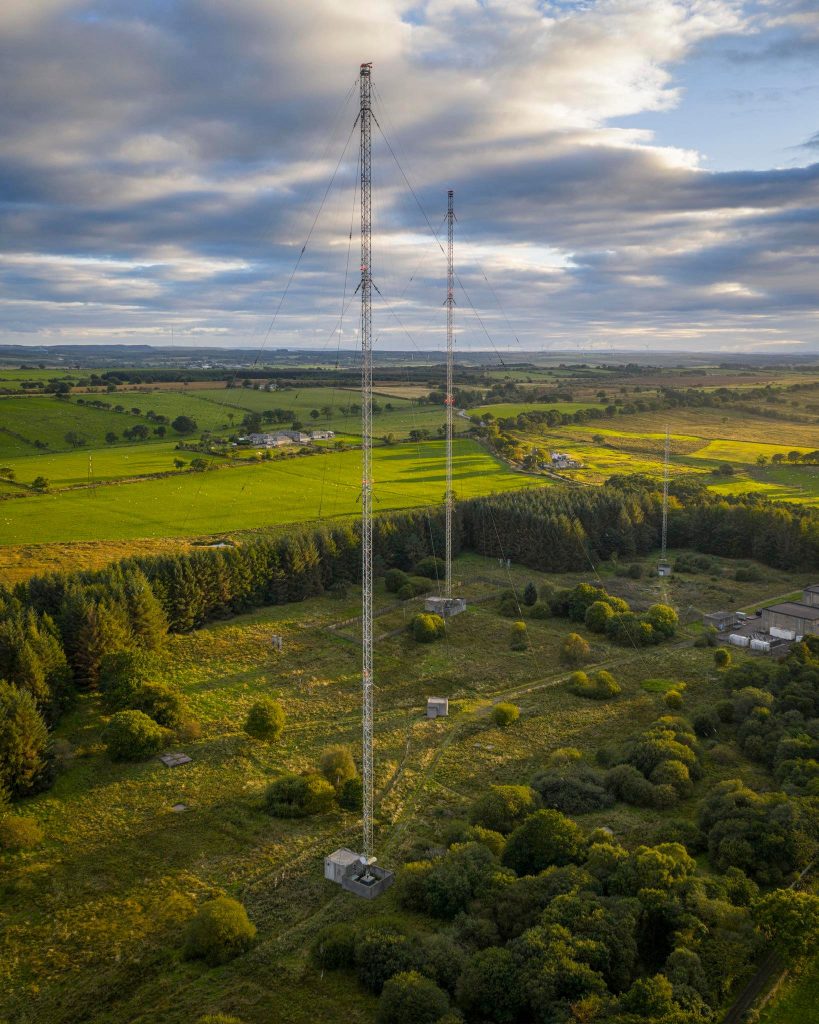
(Westerglen Aerials – Photo from Scotdrone, used with their kind permission)
Here a single mast with a capacity hat is used for Long Wave transmissions.
Burghead
Burghead transmitting station is located near the small town of Burghead on the Moray Firth, some 35 miles east of Inverness, in Scotland.
Constructions work began on 14 January 1935. It opened on Monday 12 October 1936, two years after Droitwich.
Again, a single mast with a capacity hat is used for Long Wave transmissions, the second tall mast is used for Medium Wave transmissions.
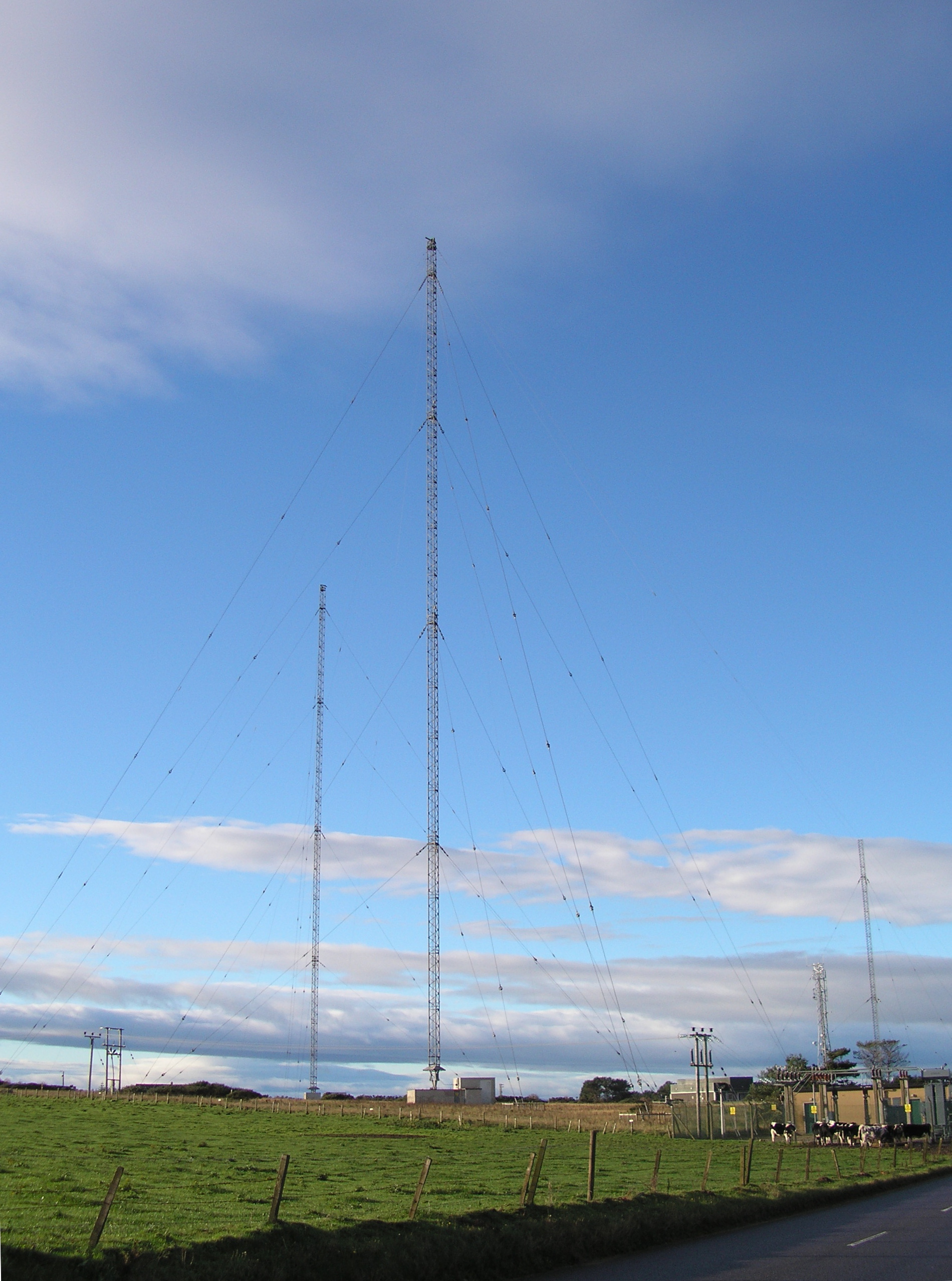
(Burghead Aerials – Photo from W. L. Tarbert, used with their kind permission)
BBC Long Wave and its place in British Society
The BBC’s Long Wave (LW) service, broadcast on 198kHZ from the Droitwich Transmitting Station (and its two Scottish sister stations), has played a massive, historic role in British society. For decades, it provided a uniquely national unifying voice, spanning the entire UK and reaching far into Europe. It was the voice of the BBC in countless homes throughout the United Kingdom and beyond.
Long wave broadcasting has left an indelible mark on British life and culture, acting as both an essential lifeline and an enduring cultural touchstone:
- Unmatched geographical reach: Because of the physical properties of low-frequency radio waves, a single LW transmitter can blanket the entire UK—covering over 90% of the population—as well as reaching rural areas and maritime waters where FM, DAB, and internet signals struggle.
- The voice of British mariners: The broadcast of the Shipping Forecast has become a legendary cultural institution in Britain. For generations, this rhythmic, four-times-a-day reading of coastal weather areas (like Dogger, Viking, and FitzRoy) has offered comfort, nostalgia, and an iconic cadence that is deeply ingrained in the British psyche.
- National and specialised content: Long wave long served as the home for distinct programming on BBC Radio 4, including the live uninterrupted coverage of Test Match Special (cricket) and extended editions of Yesterday in Parliament.
- Letters of last resort: Due to its immense range and durability, the signal has been a critical component of the UK’s national security infrastructure, used to communicate with the Royal Navy’s nuclear submarines.
Below we have a collage of images from wireless sets, courtesy of the Orkney Wireless Museum, mostly from the 1930s, showing the importance of Droitwich on Long Wave tuning dials. These sets are typical of those around which UK families would gather to hear news of War and Peace, of Sport and of Politics and Royal Succession.
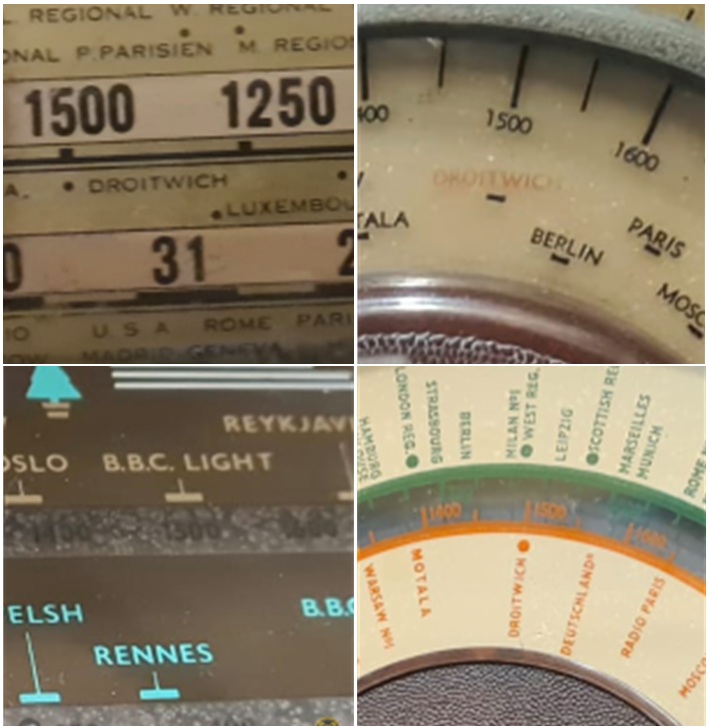
(1930s wireless tuning dials at the Orkney Wireless Museum)
Special call sign activation for RSGB and BBCARG members

The RSGB and the BBC Amateur Radio Group will be marking this occasion on the air and are looking for volunteers to activate the call sign GB1500M in the week leading up to and including the day of the closure. 1500m was the wavelength of the BBC Long Wave transmissions for many decades. Operation will be from Sunday 21 June until Sunday 28 June. Activators may be individuals or clubs operating from within the UK, Isle of Man or Channel Islands.
Would you like to be a GB1500M activator?
If you would like to be an activator you need to be an RSGB or BBCARG member with a Full Licence*. You will have to be able to link your radio to computer logging, typically using a contest logging program such as DXLog or N1MM. This will be able to store your QSOs in a local log which can then be exported as an ADIF file to be emailed, so that it can be added to the complete log for the call sign. The log will be sent to our QSL manager and also uploaded to Logbook of the World (LoTW).
Activation is open to individuals from their own homes and to clubs who may operate from members’ homes or from club stations. We welcome operators who are Foundation or Intermediate licensees who may operate under the supervision of a Full licensee.
If you would like to register as an individual or you are the representative of a club who would like to operate please follow the instructions on the page that is linked below.
*Licence conditions in the UK permit only Full Licensees to activate, or supervise the activation of Club Call signs.
Instructions for Activators
Radio Club Special Event Stations commemorating Closure Day
Closure day is Saturday 27 June 2026. We have three radio clubs who have volunteered to activate special call signs up to and including the weekend of the closure:
Cray Valley Radio Society will be activating GB198LW with their focus on celebrating the Droitwich Transmitting Station. They will include a display of vintage wireless sets at their club station.
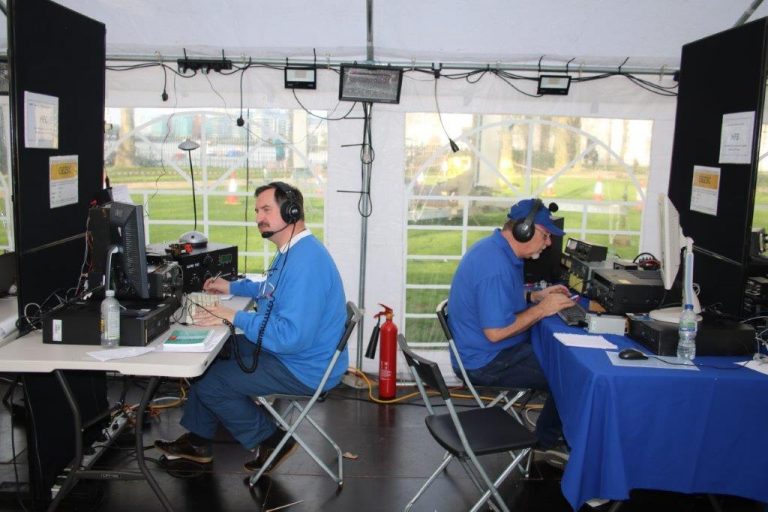
(Cray Valley RS members activating a speical event station GB23C for the Coronation of King Charles III)
They plan to be on the air with three HF stations and one VHF station. They hope to operate on Friday 26 June until the BBC Long Wave transmissions are shutdown at 1am BST on Saturday 27 June.
On Saturday 27 June they will continue to operate the four stations. The hall will be open to the public from 10am-5pm with a display of early broadcast radios, with club members on hand to explain it all to visitors. Please contact the club using the message facility on the club website for details of how you might attend.

Moray Firth Amateur Radio Society will be activating GB198END from close to the site of the Burghead Transmitting Station.

Stirling and District Amateur Radio Society will be activating GB198KHZ from close to the site of the Westerglen Transmitting Station.
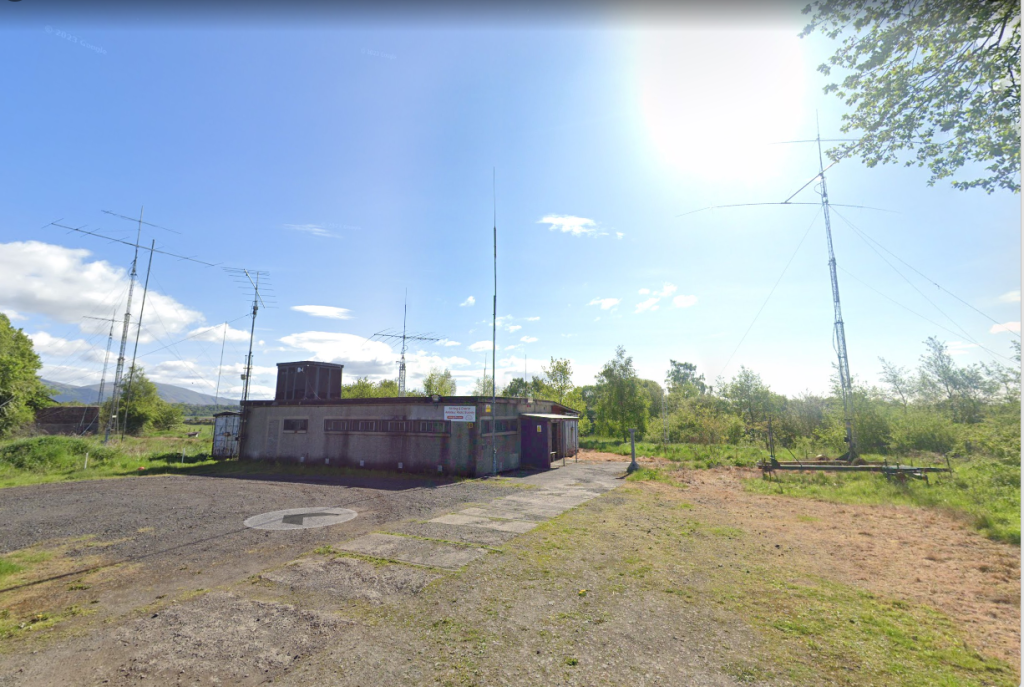
(Stirling and District ARS Clubhouse)
The club will have up to four stations running, from Thursday 25 June to Sunday 28 June, operating at various times throughout the day on 160m through to 6m, SSB, CW, and FT8.
QSL cards and LoTW updates
A commemorative QSL card is available for GB1500M, GB198LW, GB198END and GB198KHZ, via the Bureau or Direct using M0OXO OQRS.
Please do not send your card via the QSL buro. The card is also available to SWL enthusiasts; please see the instructions on the QRZ.com page for each call sign.
The logs for the four call signs will be uploaded to Logbook of the World after the event.