Becoming a radio amateur
This FAQ grid is currently undergoing maintenance. Not all the FAQs may be visible right now. If you think something is missing, please check back later and it may have been added. If not email exams@rsgb.org.uk to let us know.
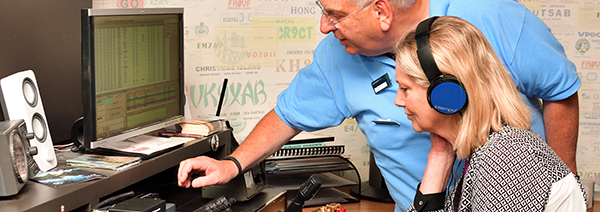
The best way to start is by listening to amateurs on the amateur bands. These are frequencies reserved for use by radio amateurs. Try 3.5MHz upwards, or 7MHz upwards for starters. There are ways of doing this even if you have no receiving equipment—see below. Listen to what’s being said, listen to how it’s done and imagine yourself in that place. For a full list of amateur frequencies in the UK see Band Plans and Information. If you like what you hear, and would like to become a member of of that community, then you can join the RSGB as a listener, and receive the monthly magazine RadCom, which keeps you up-to-date with what’s happening in the world of amateur radio and is full of ideas, advice and useful information. You can then start thinking about getting a licence yourself. It’s easy, and you will find lots of other amateurs only too willing to help you on your way—that’s part of the ethos of being a radio amateur. You can find out more about getting a transmitting licence in these FAQs or by visiting our Training pages.
You'll need a receiver to tune into them, and a suitable antenna, or aerial, which can be as simple as a long piece of wire. If you haven’t got any equipment of your own you can listen to one of the internet software-defined radio (SDR) websites—like the RSGB WebSDR site—which allow you to listen to amateur radio frequencies over the internet. The advantage of listening online is you don’t need special equipment or have to put up aerials. Alternatively, you can go along to your local amateur radio club and ask to listen in using their equipment. Club members are usually very helpful towards newcomers and can be a very useful source of information for the beginner—i.e. where to find second-hand equipment, which are the best rigs to get hold of, how to build your own receiver, etc.
Use our Club Finder tool to find radio clubs near you.
No problem. There are lots of amateur radio training resources on this website, and the RSGB also produces and sells a wide range of amateur radio tuition materials.
Any one can listen to the amateur bands, but you need a licence to transmit on them. Your first amateur radio licence is the Foundation Licence, which is designed as an easy-to-achieve goal to get newcomers on the air quickly. About 12 hours tuition is normally needed to prepare for the examination, and if you have existing knowledge of radio or electronics, it's likely to be less. No formal training is required but you need to learn enough to pass the written examination. The Foundation exam itself is straightforward and consists of 26 multiple choice questions which you have 60 minutes to answer. The exam is usually taken online, either at home with a remote invigilator, or in a club setting. You will be given your result immediately after you complete the online exam, together with feedback. There is a set fee for taking the examination, and some physical exam venues may levy a small additional fee to cover room hire, etc. There is no lower age limit for taking the examination, but candidates must be able to read and understand the amateur radio licence, the training book, be able to recognise and use fractions and decimals, and sit a formal examination. The RSGB booklet Foundation Licence Manual provides all the information you need to take the Foundation Licence examination.
The Radio Communication Foundation (RCF) offer fully funded Foundation exams if you are under 21 and in full-time education.
If you’re an Air Cadet preparing for your Communicator’s badge and have passed the ACO Equivalent examination, this is accepted by Ofcom as the exact equivalent of the RSGB Foundation examination, and no fee is incurred. You can apply online.