Chris Whitmarsh, G0FDZ – October 2025
Chris Whitmarsh, G0FDZ died in October 2025 at the age of 73.
He was a pioneering microwave operator and a constructor of unparalleled ability. Always ready to provide help and guidance to others, he was a stalwart member of the North Kent and Cray Valley Radio Societies and a founding member of the Windmill Contest Group.
He helped generations of amateurs to get started in the hobby.
Chis first discovered amateur radio in the late 1960s. At the time his main interest was chemistry but once he found amateur radio, that went by the wayside. First licensed in 1969 as G8CIU, he developed an early interest in UHF and microwave operating. In 1986 he passed the Morse test and became G0FDZ, the main motivating factor being that, with Morse under his belt, he would be able to make microwave contacts on marginal paths that would be impossible on SSB. This was before the adoption of digital modes for weak-signal working on microwaves.
Always an outstanding home constructor, equipment for most microwave bands had to be homebrew and here Chris excelled. When the UK gained LF allocations, he again built equipment to a very high standard to get on those bands as well. He had the unique distinction of having made at least one two-way QSO on every single band for which we are licensed in the UK – from the 73kHz band no longer available to amateurs up to what the microwavers call ‘topband’ – 241GHz.
In recognition of this achievement, which is unlikely ever to be paralleled, in March 2024 he was awarded a Lifetime Achievement Award by the RSGB President John McCullagh, GI4BWM. Although by that time Chris found movement difficult, he was able to get to the meeting of Cray Valley RS where the award was presented.
Chris served for several years on the RSGB Microwave Committee and over the years he set many UK microwave records, most of them with Roger Ray, G8CUB. At the time of his death, Chris and Roger held the distance records on both 241GHz and 288GHz. Chris was a regular at Microwave Round Table meetings and was often called upon to give lectures at the round table and at clubs in the southeast. Although very ill, he was able to give his last talk at the Crawley Round Table in 2024, with assistance from his son Julian.
Chris lived in Sidcup, south-east London and served twice as Chairman of his local club Cray Valley Radio Society in the 1980s. Subsequently during a long period as honorary Vice President, his advice to committee was invaluable and he was also the club’s archivist.
When the new Ofcom licence structure came in, he took the lead in organising the club’s Foundation course and presented many of the modules. Intermediate and Full licence courses followed a couple of years later. It is a testament to his leadership and attention to detail that Cray Valley RS remains one of the few clubs offering in-person training at all three levels to this day.
Chris held the position of Beacon Keeper for the GB3VHF and GB3UHF beacons for many years. In 2005 he led the rebuild of both beacons to a new design, setting the standard for modern VHF/UHF beacons and incorporating a JT65 message for the first time. In 2010 he managed the task of moving the Wrotham beacon to a new site a few miles away at Fairseat. Both beacons are still on the air and continue to provide invaluable propagation information.
One of his great enthusiasms was VHF Field Day. Although a perfectly capable operator, his strength was organising and logistics, not forgetting trips to the pub and curry house. Over a few beers his sense of humour came to the fore. He built an early DVK that was used to send CQs on the 23 cm band so his voice was in the ‘Chris in a box’ unit though it was seldom he who came back to any callers. The 23cm station used a water-cooled valve amplifier, homebrewed by Chris of course.
He was also a great supporter of Cray Valley RS expeditions for the IOTA Contest, where again his organisational and planning skills contributed hugely to the success of the trips. IOTA expeditions were initially to the Isles of Scilly but Chris and Nobby, G0VJG planned more ambitious ventures including trips to the Minquiers between Jersey and France (twice), St Kilda and the Monach Isles in the Outer Hebrides.
Chris was part of the three-man Cray Valley RS team that organised the M2000A special event station in Greenwich to mark the Millennium and then went on to organise GB50 at Windsor Castle in 2002 and GB200T at the National Maritime Museum in 2005. He played a key role in planning the 2O12L station for the London Olympics and most recently he joined the GB23C special event at Greenwich Maritime for the Coronation of King Charles III, though he was quite ill by that time.
Professionally, he started his working life as an apprentice engineer with the Post Office, later BT, working on telephone exchange equipment. In the 1980s, on the basis of his technical and construction skills, he was invited to join satellite telecommunications company Inmarsat, which at the time had the status of a non-profit intergovernmental organisation. He worked on innovative satellite technology and made frequent trips to the Goonhilly Satellite Earth Station at Helston in Cornwall.
Together with many other employees he left when Inmarsat was being prepared for privatisation and he took a post as a school science technician. He soon progressed to teaching classes on computer construction and gave many youngsters a route into a career in IT.
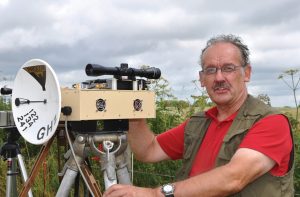
Chris Whitmarsh: He helped generations of amateurs to get started in the hobby.
Throughout his life, Chris was always prepared to give his knowledge and experience freely and he gave very many their introduction into the hobby. His abiding interest was microwaves and his skills were unparalleled. His achievement in making two-way contacts on every band for which we are licensed, much of it with home-made gear, will never be equalled.
Category: Silent Keys, Uncategorized