GR2HQ 2025 Story
We had made improvements to the infrastructure at many of our Host stations for 2025. This year the 15m SSB slot was activated from Martin GW4XUM’s location in North East Wales.
Each year we ask if there are any contest enthusiasts who would like to join the operating team, either at a host station or as a partner operator and this year we had some new team members at some of the host stations and also had some new Partners. There are some unusual aspects to taking part in a networked team, when contesting is most often a single-handed pursuit; this is particularly true of the use of Partner Mode where trusting the callsigns provided by partner operators is key to success.
In 2025 we experienced much poorer propagation on the higher bands that we did in 2024. This meant that signal strengths were lower, particularly on 15m and DX QSOs were much fewer on both 10m and 15m. The impact of the reduced propagation in the Northern Europe was that it was much harder to compete with other European HQ stations that were further south and consequently had better propagation.
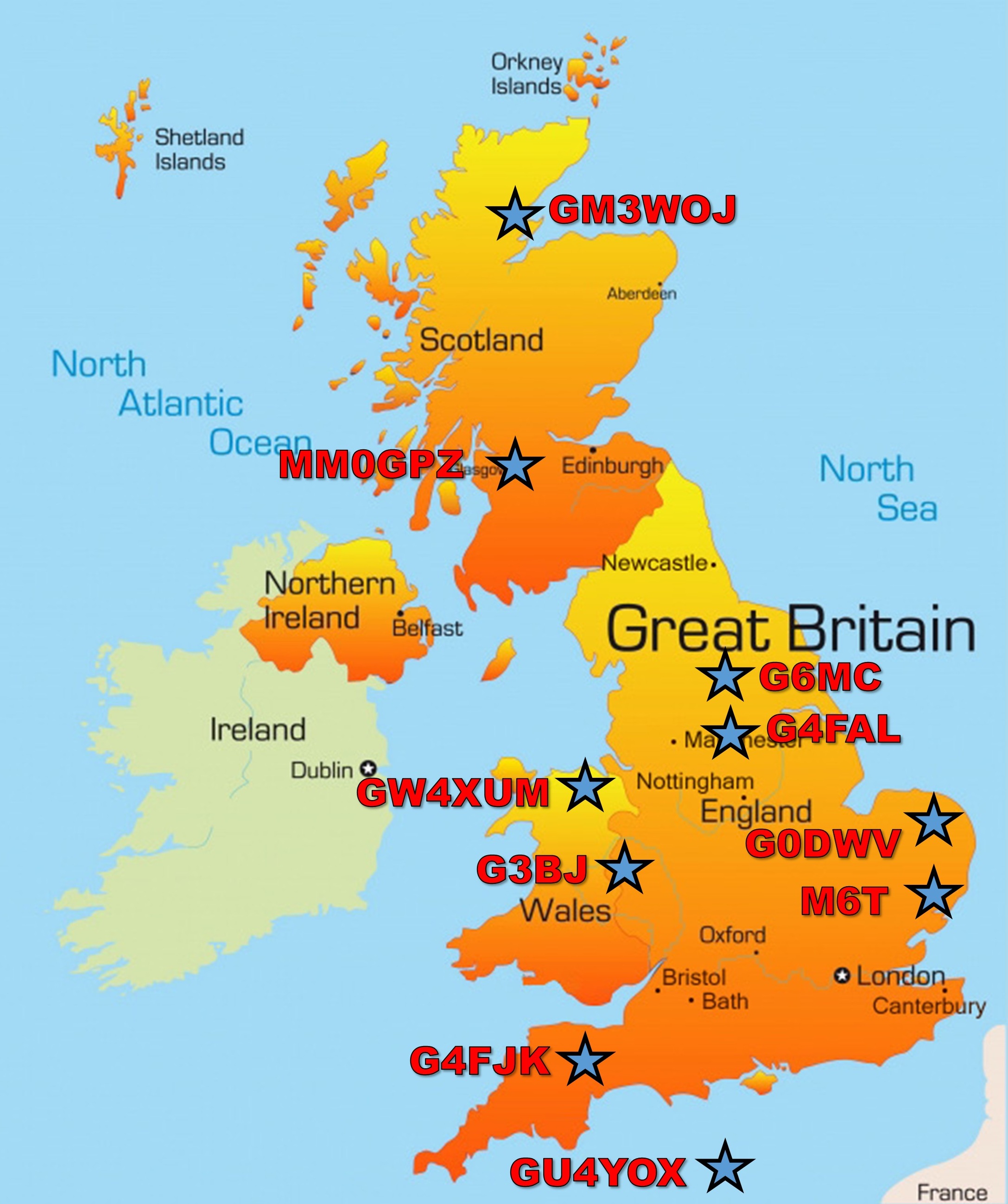
(Map showing GR2HQ host stations in 2025)
The teams at each host station have produced summaries of how they found the contest (team member call signs in brackets).
160m CW@G4FAL
On 160m CW we used a top-loaded vertical to transmit and had a three beverage receiving aerials, one East, one North and one West. We started operating at 6:30pm clock time (17:30 UTC) and quite soon we started making QSOs. Most QSOs were with European stations. About two hours before sunrise we had a propagation opening to North America and the Caribbean – the QSO furthest west being with VE3EJ in Ontario, Canada. We worked through the band-map trying to work all the stations that had been spotted. We stopped operating when there had been no more callers and there was nothing to be heard, just after sunrise. (M0HDF G4DRS G4FAL)
160m SSB, 80m SSB & 40m CW@M6T
Operating from M6T is a bit like a Field Day operation as most towers are left at ground level with all wire antennas returned to storage between events. M6T is ideally suited to M/M events with the current set up as each band uses a separate operating room.
The in-band RX capability is vital, but takes several hours to deploy each time the station is used.
Then there is the constant rodent damage and broken items to be fixed as the team returns to site, start-up kit (or not) as the case may be, i.e. when cranking up the big 40m beam (hard work) only to find the feeder/rotator cable has gone open circuit despite it being OK at ground level, although this did not happen this year.
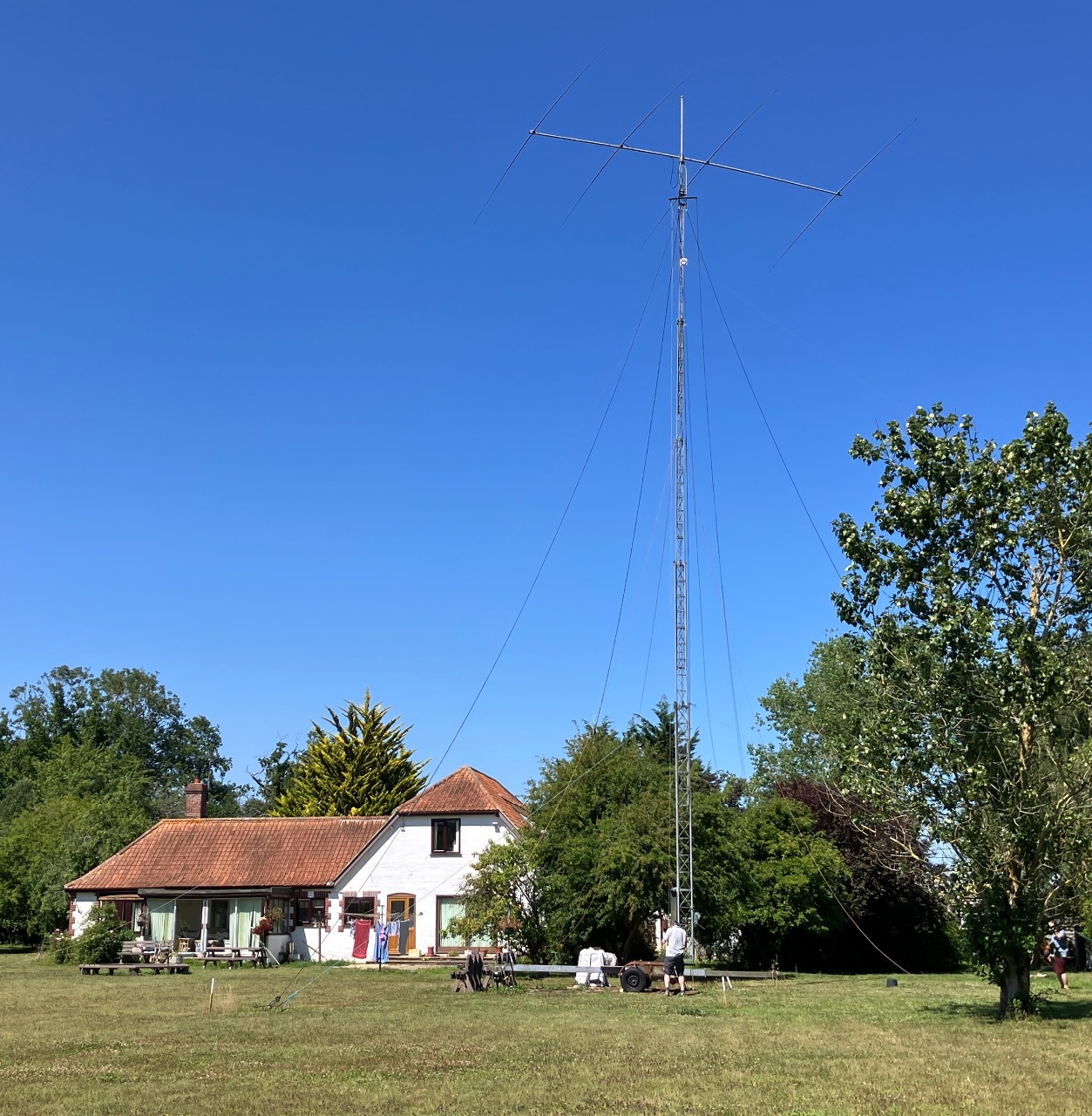
(We had an 80m dipole attached to one of the 20m towers, which complemented the 4SQ well for close-by contacts. Here the tower is in process of being raised to full height.)
All this activity usually happens 1-3 days before the start of any major event such as GR2HQ which includes all antennas, PC set up etc., whilst fixing stuff. So it is all rather hectic and quite tiring. This is not good pre-event rest time for any ops, especially those expected to undertake a long shift from the kick off.
It was touch-n-go whether we opted to host 160m SSB this year; however our real bottle neck as always is CW ops. Perhaps we will have to limit our commitment for future events to fewer Bands but this seems such a waste when have the necessary kit but no one to drive it.
One of the previous operators described this trying to cover several bands with insufficient ops, as “Optimally Undermanned”. Meaning, we are doing the best we can.
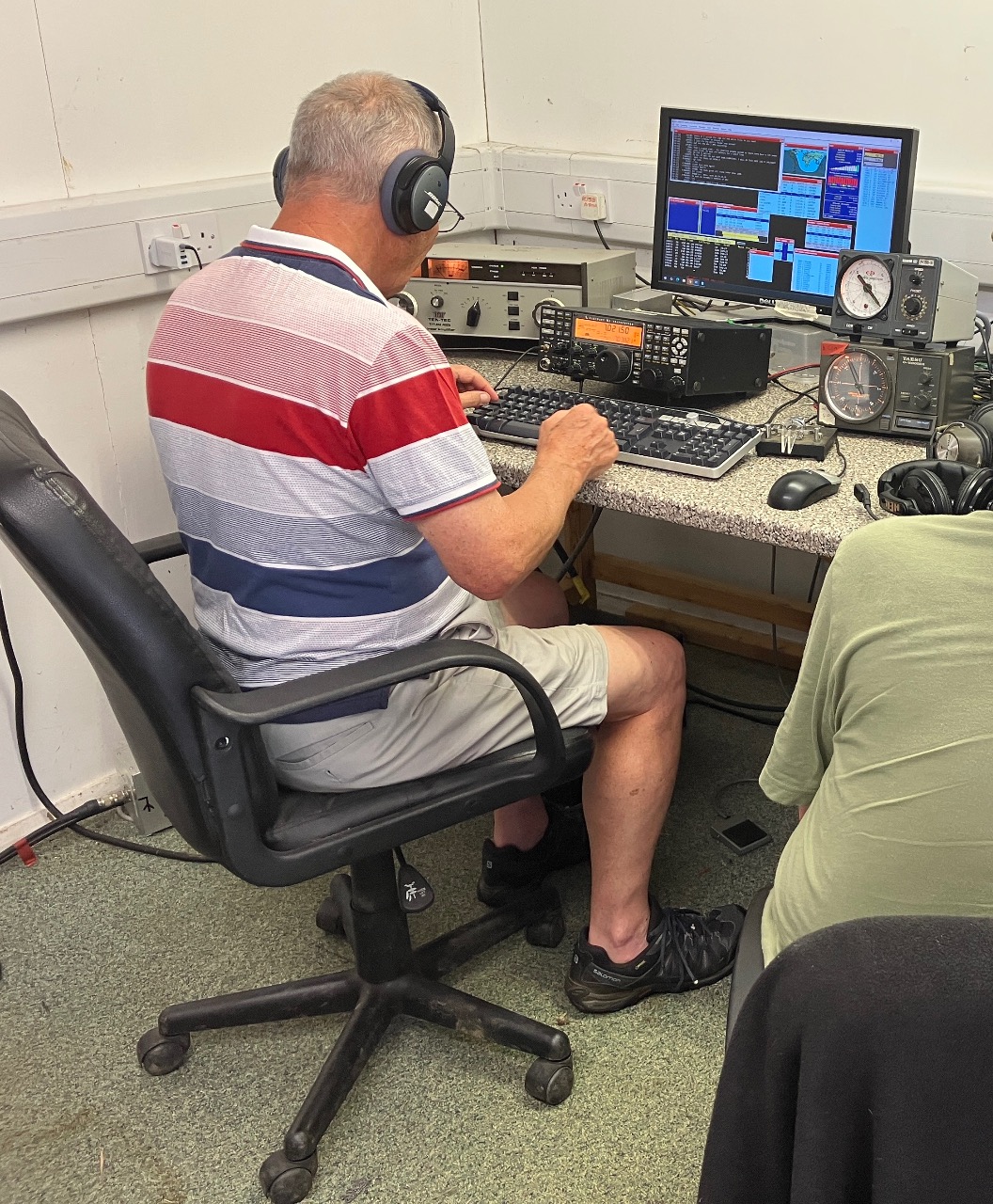
(Tony G2NF on 40m, with dual K3’s including 2 and 3 element Yagi’s)
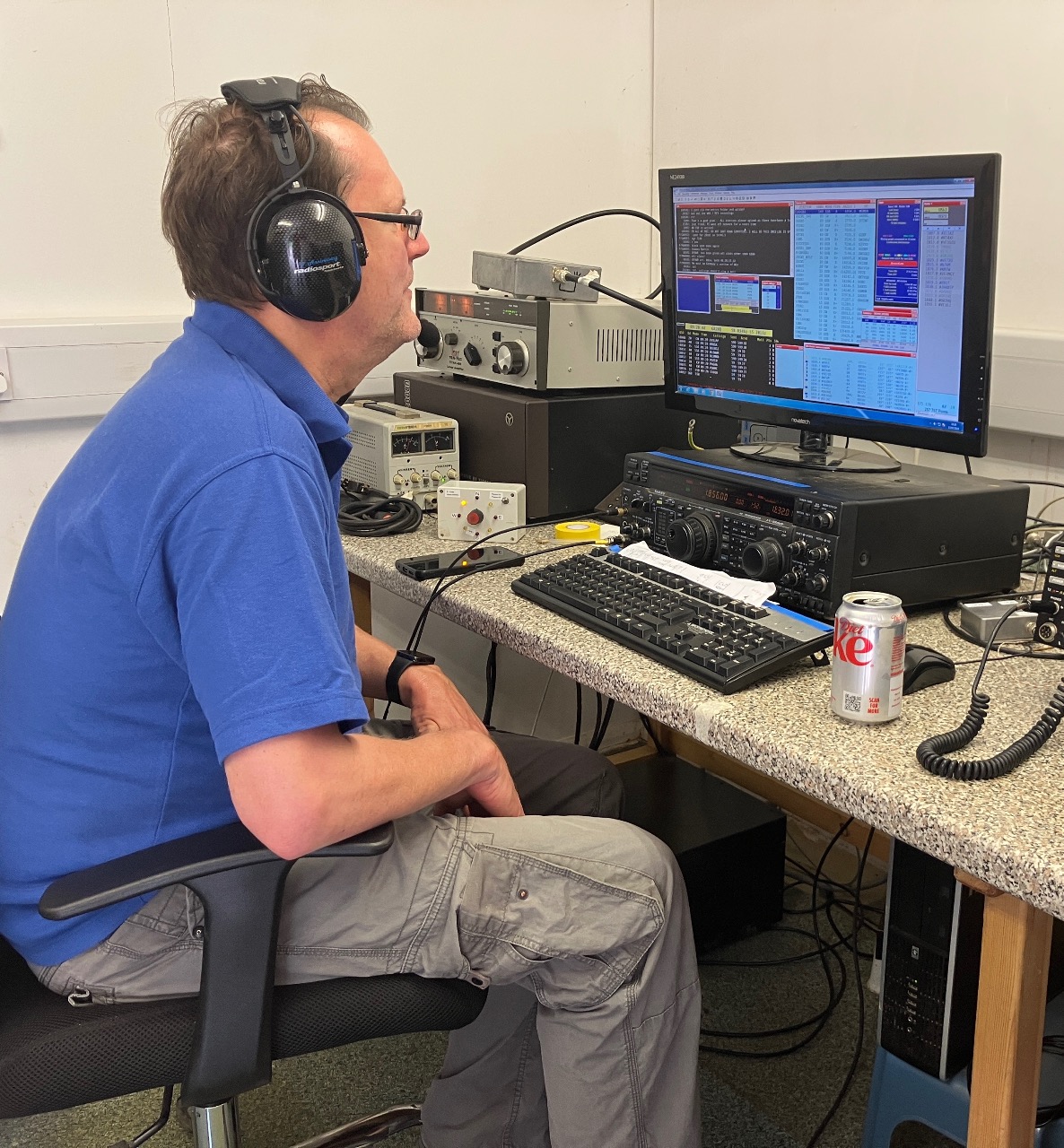
(Martin M0MDR on 160m SSB)
As you can see, we ran a 1000MP on 160m SSB without any DVK or uHam, + one K3 out of view but of with but no 2nd RX fitted as the usual k3’s needed by the WRTC26 test event stations.
Antennas for 160m this year was a dipole on the 2nd 20m tower; we opted not to deploy the 160m top loaded vertical as insufficient time & manpower. The 9-circle RX array had sustained damage since last used. This was probably due to a nearby lightening event as the small verticals (+ pre amp) were left erected. The complete setup is currently undergoing some urgently needed TLC to restore it.
Still, this helps to keep us fit and we seem to enjoy it, but additional ops always helps with setup and final score etc. (G4MJS G7TWC G2NF M0KYB M0BPQ G0AEV M1CKD G4PVM M0MDR)
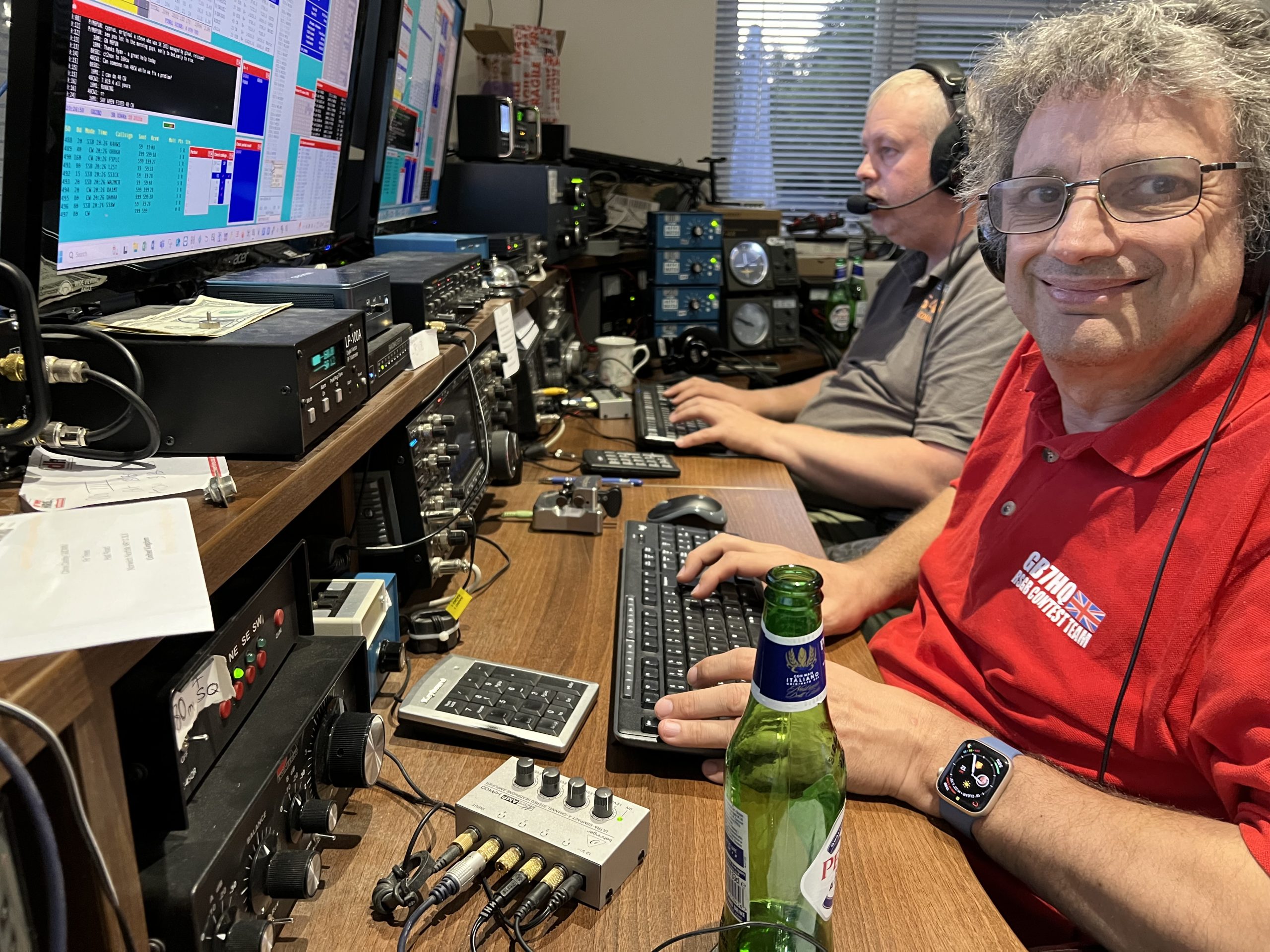
(Jonathan G0DVJ operating GR2HQ on 80m CW)
80m CW@G0DWV
Here we had a high dipole and a four square array for transmitting, as well as separate directional antennas for receive. As usual, this band/mode slot started off very slowly on the Saturday afternoon before the busy period in the evening and overnight when DX was able to be worked. Not being as busy as the higher bands, we were able to pick off multipliers on the second receiver while calling CQ, especially in the long periods when no calls were answered. A few stations did call us on Saturday afternoon and Sunday morning. As we approached darkness in North America, around midnight our time, that continent provided a decent number of contacts.
(G0DVJ G4FNL G4LPP M0NKR)
40m SSB@G0DWV )
Chris, G0DWV hosted the 40m SSB station at his rural QTH, just north of Norwich in Norfolk; the station also co-hosts 80m CW. Hosting both 40 & 80, usually brings about some interstation rivalry with M6T hosting 40 CW and 80m SSB in Suffolk. SSB is more tiring that CW and on 40m that is definitely the case. The mixture of noise/splatter and general mayhem is exhausting, digging out weak DX, west coast US stations and HQs with 40 over 9 EU signals close by is made worse by having a big antenna system.
The 40m station consists of a large Optibeam 17-4 (3 elements on 40) yagi @32m, ICOM TRX and an Alpha 87A amp, firing via a stack match to both the Optibeam and a 40m Cushcraft D40 rotary dipole at 80ft. This combination allowed us to work effectively 3 directions at once, which has proved very worthwhile in previous years. However with the current conditions and the higher bands being open a lot of the time, by Sunday morning we were working practically no one; EU was too close so, so we tried passing to GM3WOJ who quickly gave it back and then as the skip conditions changed and the QSO rate fell to 1 Q every few minutes or slower, we passed to Steve GW0GEI, who was partnering us and hearing EU stations that we were not; so he closed the contest for us a couple of hours early. We could not hear many of the stations he was working in the last hours, so maybe we should consider this strategy next year when the band goes short. We and the 80CW boys had a great weekend.
(G0DVJ G4FNL G4LPP M0NKR)
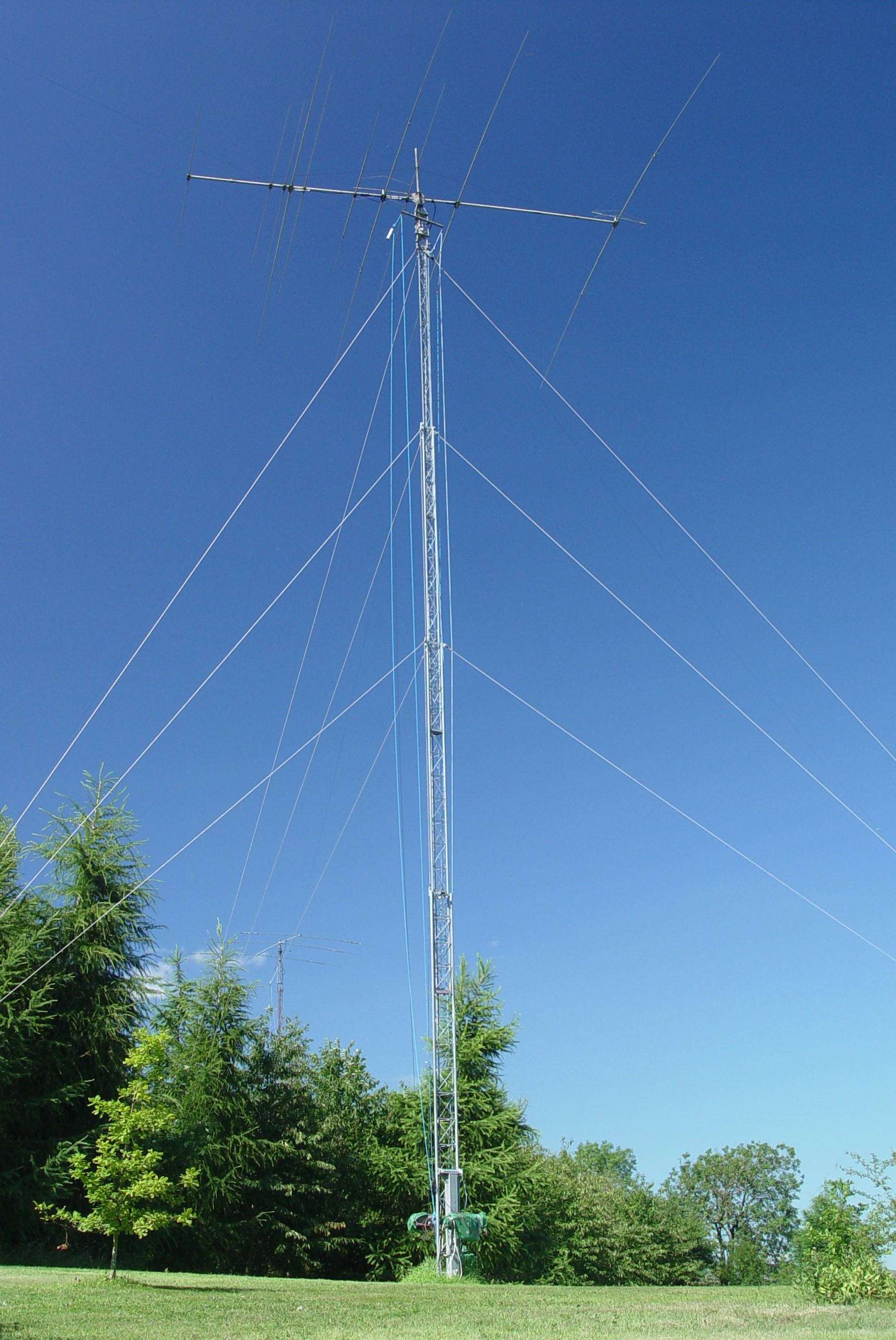
(One of the 20m CW yagis)
20m CW@G3BJ
At 20 CW we used three yagis, a full-size tri-band yagi at 75ft, a second at 60ft and a third at 40ft fixed on short-path Far East. Two FTDX101’s were used with linear amplifiers and a “first one wins” controller allowed one operator to run QSOs and the second to look for multipliers and interlace his calls with the run station.
Conditions were not as helpful as in 2024, and although the initial run rate to the USA was higher than last year, propagation overnight was poor, with low rates to the US. Overall, the percentage of US QSOs in the log dropped from 34% to 32% and of non-EU QSOs down from 42% to 41%. Overall QSO count was down 4%. We hope for better in 2026! (G4IRN M0BEW G3BJ)

(M0CTP and G7SLP on 20m SSB)
20m SSB@G6MC
The 20m SSB team made some improvements this year, with improved software infrastructure to control rotators and synchronisingof run and in-band stations. We used an audio mixer to allow the in-band operator to select and mix audio from three different receivers/antennas: the two 4-element yagi antennas used by the run station as well as a receive antenna connected to a LAN-connected SDR 300m from the main antennas. While the network lag prevented the seamless mixing of the audio feed from the receive antenna with those from the transceivers, the receive antenna was useful on its own to scan portions of the band even when the run station was transmitting.
As usual, there were last minute issues that needed attention. One of them proved harder to solve, so we had to operate the whole contest without voice keyers.
The team was the same as last year, and as we become more familiar with each other’s operating styles we are working better together and using partnering more efficiently. Unfortunately, poor band conditions meant that the improvements did not translate into a better final score. (G4MEM G4RCD G4YTD G5KC G5LSI G7SLP M0CTP)
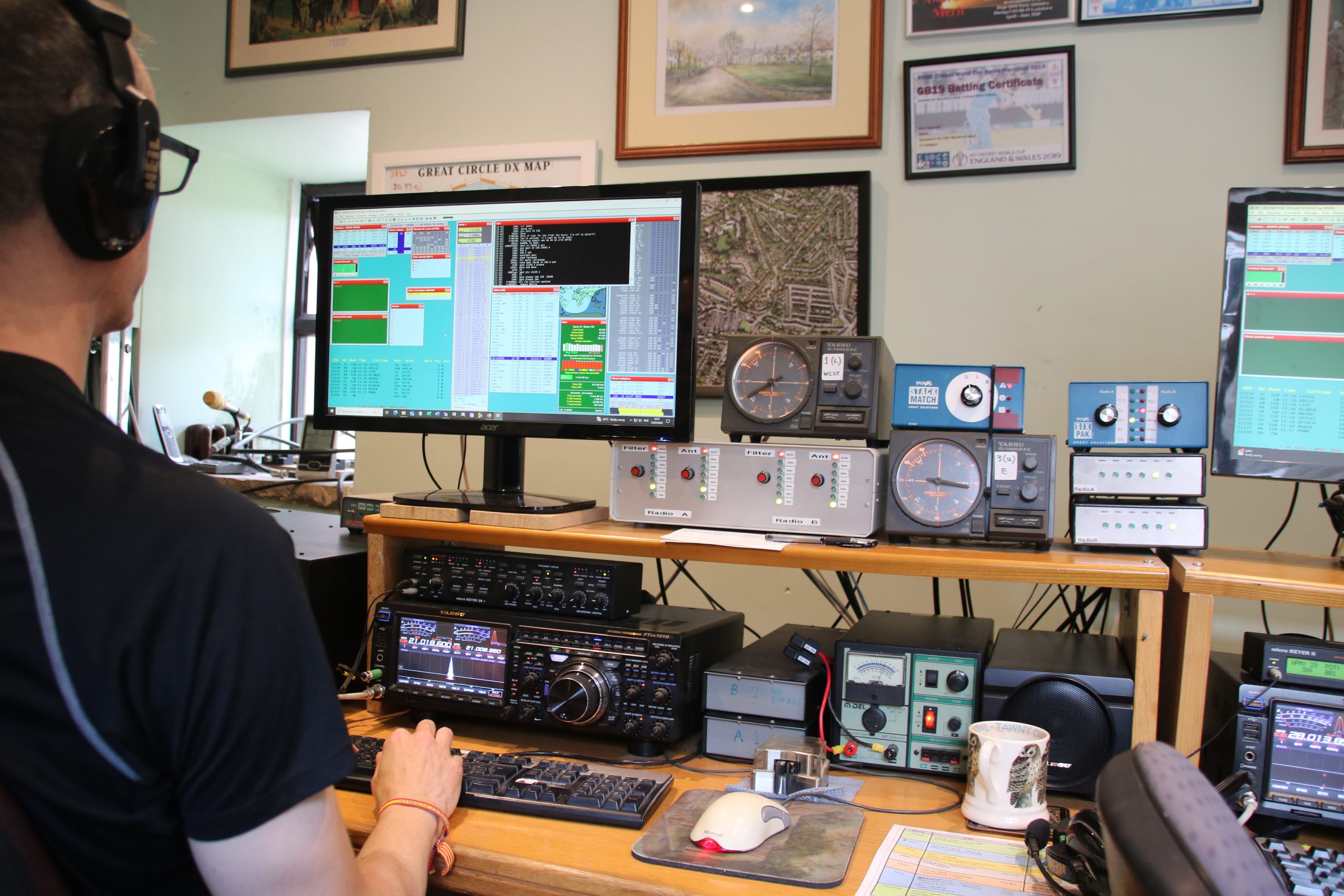
(Angel M0HDF operating GR2HQ on 15m CW)
15m CW@G4FAL
15m CW was quite hard-going this year – a contrast with 2024 when the band had been open to someone for the whole 24 hours. This year we had improved the station with two antennas: three elements at 80 feet and four elements at 60 feet but without an in-band station to mop up non-DX stations that were not on our run frequency. (M0HDF G4DRS G4FAL)
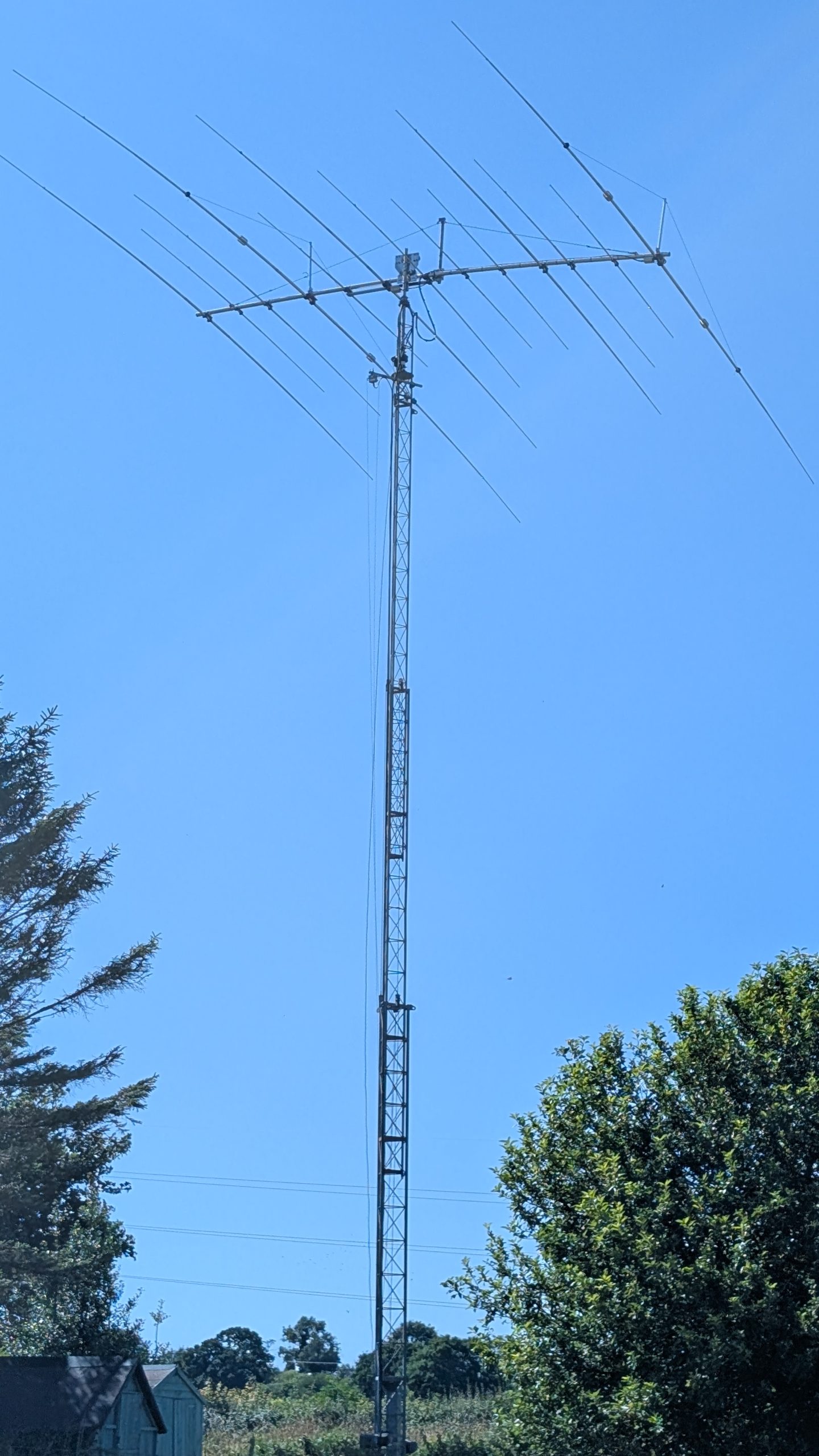
(Multiband yagi at GW4XUM)
15m SSB@GW4XUM
15m SSB utilised three yagis. We had a full-size yagi at 75ft, a second at 60ft and a third one of which was put on a temporary mast specifically at 50 feet for US stations. The radio was a Flex 6600 for run and an interlocked K3 for inband QSO’s which grabbed the main antenna on TX but utilised a loop on RX. Conditions were pretty dire with no sporadic E and poor F2 – we worked 1 US station all weekend. We also had a receive problem which dogged us throughout which was only diagnosed upon tear-down after the event. (GW4XUM G3NKC G4BVY)
10m CW & 10m SSB@Various Locations
As in previous years, we had a network of five stations across the UK, all prepared to take responsibility as the Run-station on either 10m CW or SSB. Compared to 2024, our performance on the 10m band this year was rather disappointing, but had some DX highlights.
North/South F2 paths did appear, the best being to all parts of South America, but the majority of our one-thousand 10m QSOs were to Europe via some very patchy, intermittent Es propagation.
We had just 30 QSOs with North America on 10m, all on CW via multi-hop-Es, but each one brought a bit of cheer to our operators, and probably to the stations that we worked too!
When conditions are this poor and the band is very quiet, it takes a lot of patient calling and constant monitoring to find the brief openings that can provide short runs of QSOs and valuable HQ and Zone mults.
It was a good team effort, but we all look forward to better conditions next time. (GM3WOJ Inverness, MM0GPZ & GM0EGI Blantyre, G0AEV@M6T Suffolk, G4FJK Devon and GU4YOX Guernsey)
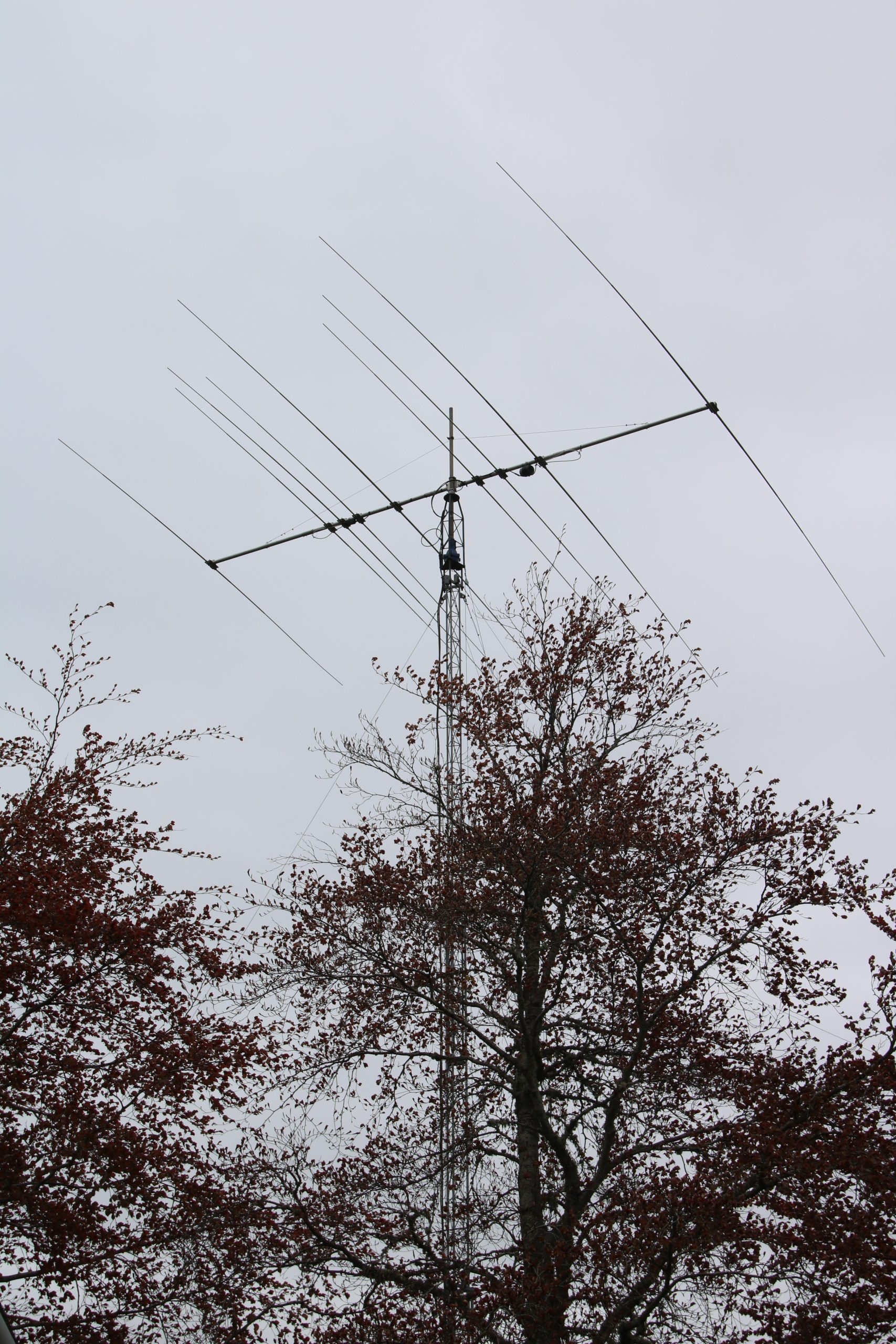
(part of the GM3WOJ antenna farm)
Detailed experience of GR2HQ activation at MM0GPZ on 10m (and elsewhere)
Brian GM0EGI and I, Gordon MM0GPZ, were one of the five designated 10m stations for GR2HQ in 2025. Although this was my 5th year in the GR2HQ team it was Brian’s first time. Working in GR2HQ can be quite complicated but as Brian had been using Wintest for many years, we decided he could learn the ropes on the day. That proved to work well although Brians initial thoughts were that it was complicated. However, after a short while operating, everything fell into place with little support from me.
My station is simple compared with many of the other groups in the team, with just a single Optibeam OB11-3 attached to my FTDX101 and Acom amp. It is a very effective tribander with 5 full size elements on 10m and 3 full size elements on 15 and 20. The station is at 190m ASL in a quiet location.
Initially we were tasked with sharing the running of 10m SSB, but could run CW if asked. We had also been asked if we could try running 15m SSB to see if propagation was favourable from GM later in the evening. As it happened, we ended up running 15 SSB a few times due to technical issues that affected another 15m station. Our 10m team members were in Guernsey, in Devon, in Bury St Edmonds and in Inverness with ourselves at Blantyre 10 miles SE of Glasgow – a UK-distributed team. The idea is to move the operating around the UK to best suit the conditions. This often works amazingly well on 10m, and we have been very useful in previous years.
This year however, 10m really didn’t really turn up in Scotland. At the start and our CQ’s were going unanswered. It was obvious that the southern ops had a propagation advantage as they could still make some QSO’s although several were with groundwave G stations.
The best hour in day one was 70 QSO’s from 1500 to 1600z. 10m was very slow. We had hoped that propagation would open later as had happened in previous years but 10m was completely dead from around 21z. On Sunday, we got up early hoping for better early morning propagation. That unfortunately didn’t happen, and the band was still very quiet for us.
As the morning progressed, finally there was some sporadic E type propagation although pretty poor, it was enough for us to be able to make a concerted run. The best hour of the contest was from 0900Z and 155 QSOs were logged, and many were made from Blantyre. We were swapping between CW and SSB. The next 2 hours were slower, but we were still making QSOs. Sunday was overall much better than Saturday on 10m. (Gordon MM0GPZ Blantyre)
Partners
G3YYD David – Leicestershire
GW4BVJ Richard – Ammanford
GW0GEI Steve – Ceredigion
GM7VSB Jason – Argyle
G4BYG Vic – Yorkshire
MW0BRO Martin – Pembroke
M0PUN Ryan – Devon
G3VCQ Colin – Yorkshire
Outcomes in 2025
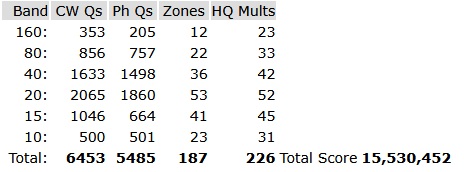
(GR2HQ Claimed Score 2025)